
Phono preamplifiers · User manual
GP-1000 user manual
Audiophile Phono Preamplifier
Thank you for choosing the GP-1000 phono preamplifier. We appreciate your confidence in us for such an important purchase, and we built it to give you command over the sound your system produces.

Specifications
As engraved on the unit.
- Frequency response
- ±0.2 dB of RIAA
- THD
- Below 0.1 %
- Phono sensitivity
- 3.2 mV
- Input impedance
- 47 kΩ, RF filtered
- Output impedance
- 100 Ω, XLR and RCA
- Hum and noise
- 74 dB below 10 mV
- Gain
- 41 dB at 1 kHz
- Phono overload
- 80 mV
- Level tracking
- Within 0.5 dB
- Maximum output
- 10 V RMS
- Dimensions
- 5 × 2 × 1.5 in
- Signal path
- 100 % analog
Maximum output is 10 V RMS into 2 kΩ from RCA, or into 600 Ω from XLR. Distortion measured at rated output with an HP 334A analyzer; hum and noise across 20 Hz–20 kHz with the inputs shorted.
Before you start
Connect first.
Power last.
Four things, in this order, every time you change your system.
Read before switching on
- Make every connection before you switch on this unit and the rest of your system.
- Never change connections while the system is on. Doing so can damage your equipment.
- Always start with the main system volume turned fully counterclockwise, to off. Mishaps happen, so take care.
- Attach your turntable's ground wire to the GND post on the GP-1000 and tighten it.
Connections
From the record to your amplifier.
Use the balanced XLR outputs or the unbalanced RCA outputs. The inputs on the equipment you connect to decide which.
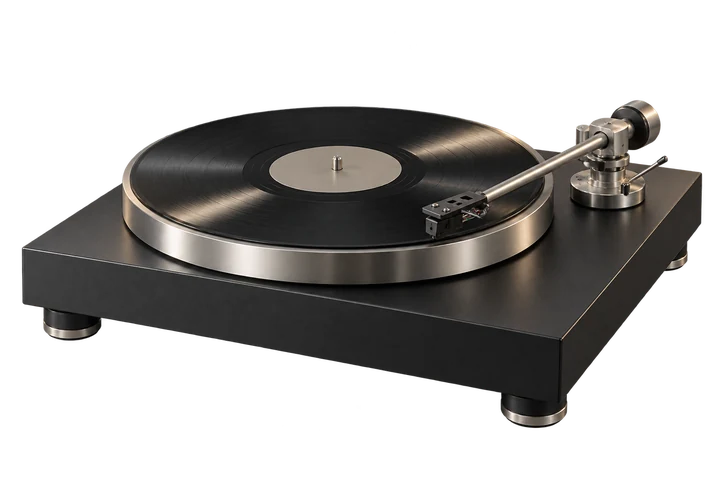

Short runs
Keep RCA cables as short as practical to avoid noise and signal loss.
Long runs
Use XLR cable for a long run to your power amplifier. Balanced lines reject the hum a long cable picks up.
RCA-only amplifier?
Run XLR the long way, then convert at the amplifier with the GP-XLR2RCA.
Set-up
Set the controls.
Before you listen, set everything like this.
-
Level
Turn it fully counterclockwise before you switch on. Bring it up once the record is playing.
Set to: off
-
Rumble filter
Switch it up. It removes the subsonic band that makes woofers flap, without touching the music.
Set to: on
Rumble and tonearm-resonance filter
The rumble filter.
The GP-1000 includes a purpose-built turntable problem solver. A carefully designed notch filter attenuates the narrow band of subsonic frequencies, from 5 Hz to 12 Hz, where most tonearm resonances occur.
This is also the band of turntable rumble that makes woofers flap at random. If that subsonic energy is loud enough to start acoustic feedback, it can damage your speakers.
The filter was modelled in P-Spice, then built with custom-made toroidal inductors resonated with very high-quality, near-zero-leakage capacitors. It is essentially transparent to the preamplifier's accurate RIAA response.
Take careWith the filter switched off, the response is flat down to 3 Hz. It can be thunderous, so take care.
Design notes
How it was built.
- 2
- Active stages per channel. Fewer stages, lower noise and phase shift.
- 0.00003 %
- THD rating of every Texas Instruments SoundPlus amplifier chip.
- 200 %
- Power derating on every device, for very high reliability.
- Only two active stages per channel, for the lowest noise, propagation delay, phase shift and group delay.
- Every amplifier chip is a Texas Instruments SoundPlus device rated at less than 0.00003 % total harmonic distortion.
- Every active and passive component in the signal path was modelled.
- All capacitors are high-quality film types or special non-polarised, audio-grade high-value types.
- All resistors are 1 % precision, industrial grade.
- Every device is derated by more than 200 % in power dissipation, for very high reliability.
Measurements
Measured and simulated.
The engineering work behind the design, as live charts. Move across one, or focus it and use the arrow keys, to read exact values.
Total RIAA response, phono input to line output, with the rumble/notch filter on. Within ±0.20 dB of the RIAA curve. Shown relative to the 1 kHz level.
Signal-to-noise ratio, phono input to line output, with the rumble filter on and off. The P-Spice simulation with the filter on matches the measured "filter on" curve to within 0.3 dB.
Redrawn from the engineering plots in the GP-1000 user manual (Rev A · October 2026). Each point is traced from the original measurement image.
MaintenanceCare
Cleaning. Use a damp cloth only, never glass cleaners or alcohol-based products.
Surge protection. Put a surge protector on the power line, against a nearby lightning strike or a line-level overload.
Questions about your GP-1000?
Talk it through with us.
Tell us what is in your system and what you want it to do. We answer set-up questions before and after you buy.